Match the PTFE grade to the joint. Specify with clarity. sales@ferrobend.com +91-8369719424

Non-Metallic / PTFE

PTFE Gaskets

Virgin, filled and expanded PTFE. Select the material grade, geometry and thickness around your flange, fluid and operating conditions.

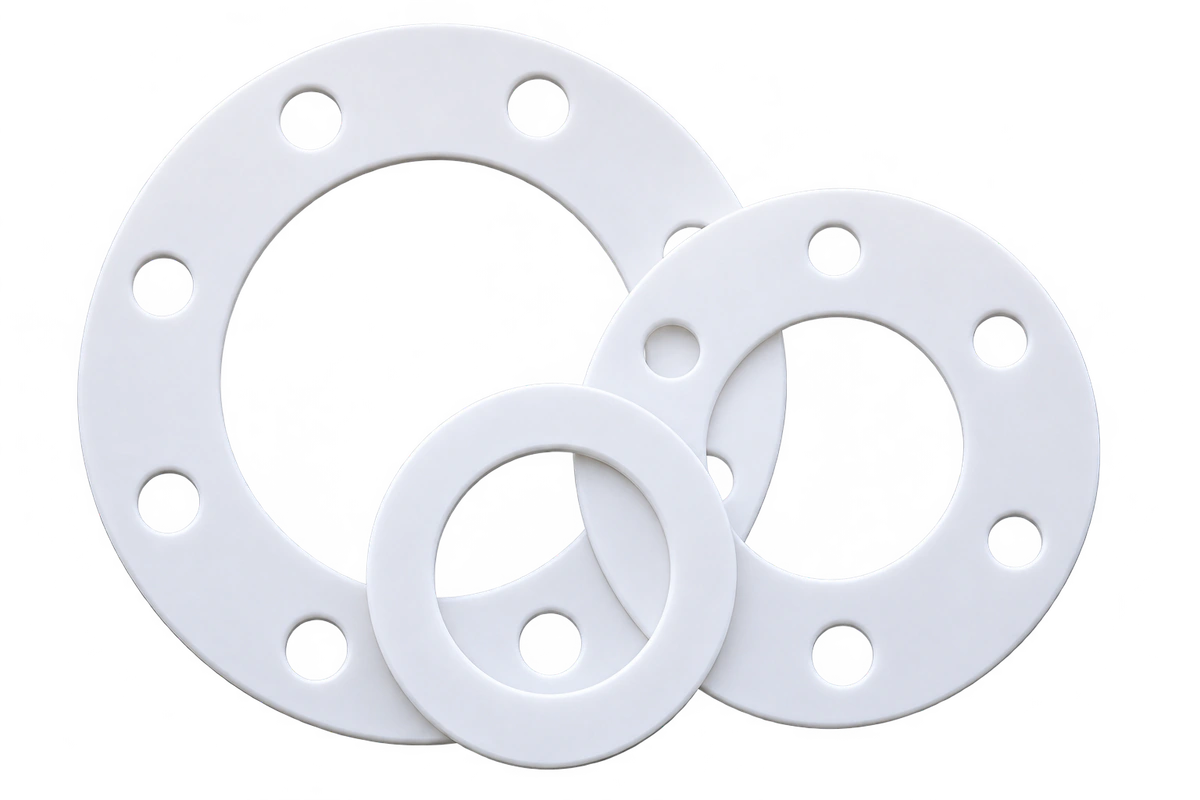
White PTFE ring and full-face gaskets with bolt holes

THE CONSTRUCTION

Fluoropolymer sealing.
Grade-specific selection.

PTFE, or polytetrafluoroethylene, is a fluoropolymer used in flat gaskets. Virgin, filled and expanded forms have different structures and mechanical behaviour under bolted load.

Select the grade, finished thickness and shape together with the fluid, flange face and available bolt load. Creep and stress relaxation need review using the material manufacturer’s data and assembly instructions.

For an envelope enclosing a separate insert, see Non-Metallic Envelope Gaskets ↗

ClassificationNon-metallic
Material variantsVirgin / filled / expanded
Joint geometryRing or full face

TECHNICAL REFERENCE

Standards & material specifications

Select the finished material grade and joint geometry together.

Dimensions & joint requirements

PTFE gasket dimensional standards and joint requirements
ASME B16.21Types, dimensions, tolerances and marking for nonmetallic flat gaskets. Match the applicable referenced flange standard, size and class.
EN 1514-1Non-metallic flat gaskets, with or without inserts, for PN-designated flange joints within the standard’s scope. Check the specified edition and flange facing.
Joint drawingConfirm ring or full-face geometry, bore, bolt-hole pattern, sealing width and finished thickness against the mating flange.

Select the PTFE grade and joint conditions together. Flange class and gasket dimensions alone cannot establish an assembly’s service limits.
Material specification references

PTFE material specifications and their scope
ASTM D4894Granular PTFE molding and ram-extrusion materials. For molded sheet made from qualifying resin, ASTM D3294 provides separate sheet requirements. Confirm the manufacturing method before specifying it.
ASTM D4745Classification of filled PTFE molding and extrusion compounds within its scope. Specify filler, type and grade, and verify applicability to the selected product.
Expanded PTFESpecify the actual sheet grade, density and thickness. Review its creep-relaxation, compressibility and sealing data for the proposed joint.

Use documented grade-specific chemical compatibility and pressure/temperature limits together with the joint design.

EXPLORE THE MATERIAL VARIANTS

Three forms. One PTFE family.

Material variants within the PTFE family. The illustrations show schematic structural differences. The selected grade determines the actual appearance and performance.

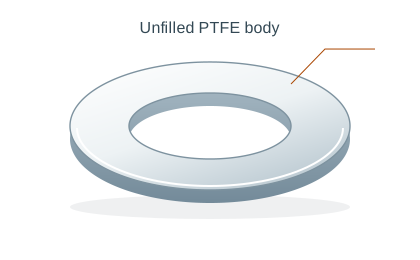
Illustrative unfilled PTFE ring gasket
01 / Unfilled material

Virgin PTFE Gaskets

Unfilled PTFE formed into the specified gasket shape. Review cold flow and creep relaxation against the available bolt load, temperature and joint conditions.

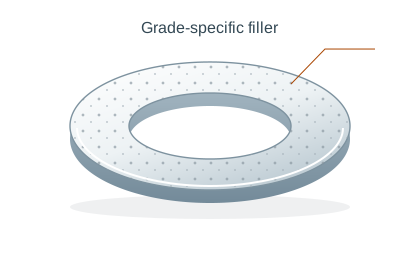
Illustrative filled PTFE ring gasket with schematic filler particles
02 / Specified compound

Filled PTFE Gaskets

PTFE compounded with a specified filler. Fillers change mechanical behaviour and chemical compatibility. Confirm composition and published data for the exact grade.

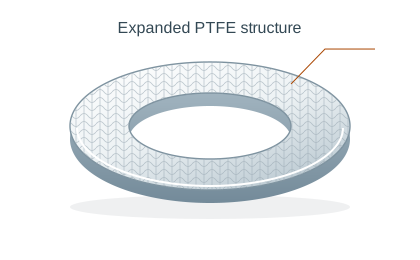
Illustrative expanded PTFE ring gasket with schematic structure
03 / Expanded structure

Expanded PTFE Gaskets

Expanded PTFE sheet with a conformable structure. Expansion direction, density and grade influence behaviour. Use the material manufacturer’s validated sealing and creep data.

Need a PTFE Gasket for Your Application?

Share the flange standard, dimensions, PTFE grade, thickness, operating conditions and quantity.

Request a Quote